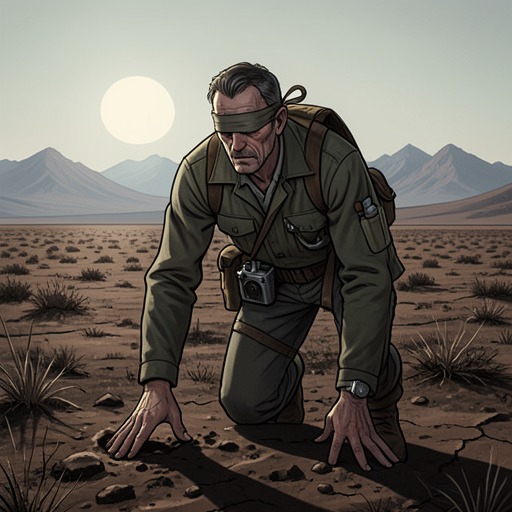
Kondo Tatsumi
World War ZKondo Tatsumi is introduced in Kyoto as a man radically altered by the catastrophe he once watched from behind a screen. The photograph of his former self shows a skinny, acne-faced teenager with dull red eyes and bleached blond streaks; the adult before the interviewer is clean-shaven, tanned, toned, and completely bald, with a sharp gaze and the controlled stillness of a predator at rest. His decisive significance lies in the contradiction he carries: an outsider shaped by social pressure and digital withdrawal becomes a warrior and a civic organizer, while remaining skeptical of the spiritual authority that guides him.
Identity and Formation
Kondo describes himself as an “otaku,” using the word in its most personal sense: an outsider. Prewar Japanese society, as he understands it, treated individuality not as a virtue but as a shameful departure from rigid external judgment. Appearance, speech, career, and even small bodily habits were expected to conform to Confucian discipline. His refuge was cyberspace, a world of freely circulating information that seemed designed for people like him.
His alienation was reinforced by the educational system. He recalls that children were trained to retain vast quantities of facts and figures, stripped of practical use, moral meaning, social context, or human connection. They were taught to memorize rather than to think. Kondo’s digital life therefore offered not merely entertainment but an alternate world in which knowledge could be accumulated without the humiliating surveillance and judgment of ordinary society.
Isolation During the Outbreak
When the infected, whom Kondo and others called siafu, began appearing, he initially treated them as objects of study rather than sources of fear. Japan might be evacuated or destroyed, but he believed he could observe everything safely from his “digital mountaintop.” His cultural upbringing, his retreat into cyberspace, and his otaku identity combined to produce a profound disconnection from the physical crisis around him.
That withdrawal extended into his family. Although Kondo lived in the same apartment as his parents, he rarely spoke with his father and had little meaningful conversation with either parent. His mother left breakfast outside his door in the morning and dinner at night, while his father apparently accepted the fiction that Kondo was studying. Even after the school closed, Kondo told them he still needed to prepare for examinations, and they did not challenge him.
The disappearance of his parents first registered as an interruption in routine rather than a personal emergency. When his mother stopped leaving food, Kondo continued to log on and attend to his habitual private activities. Only after midday hunger forced him away from the computer did he discover that no meal awaited him. He ate raw ramen, returned to his desk, and repeated the pattern that night and the next morning. Hunger, fatigue, and sexual desire seemed to him like irritating physical distractions, a revealing sign of how completely he had subordinated bodily life to the digital one.
The Escape and the Sword
Kondo’s attempt to leave the apartment becomes the ordeal that breaks his former identity. He searched for a usable weapon, considering a golf club, an exhausted aluminum baseball bat, or the possibility of finding a truncheon or firearm outside. The bat was too bent to trust, and nothing in the apartment seemed hard, strong, or sharp enough for defense. His improvised escape plan depended instead on bedsheets: descend several floors, reach a fourth-floor balcony, break into another apartment, gather more sheets, slide to the sidewalk, steal a motorcycle despite not knowing how to ride it, and flee.
The plan nearly killed him. Kondo reached the fourth-floor balcony and saw a young infected man in a torn suit, his nose bitten away, dragging his bloody face across the glass. Kondo tried to climb back up, but his exhausted arms no longer responded. When the glass shattered and the infected charged, he swung himself from the building, released the rope, and missed his intended balcony. A diagonal fall carried him onto the balcony below instead, where he stumbled into an empty apartment and collapsed from fatigue.
The photographs in that apartment confront him with a life he had never imagined: an old man surrounded by family, friends, and memories of travel. Kondo had scarcely left his bedroom, yet the photographs show him a possible alternative to mere survival. He resolves that, if he escapes the nightmare, he will not simply survive but live.
The discovery of a sword turns that resolution into a material possibility. While infected gathered outside, Kondo searched the old man’s bedroom and found a final photograph showing a traditional family and the old man as a young man in uniform, holding the weapon. Beneath bound papers and the remains of that uniform lay the sword itself: an army-issue aluminum scabbard, an improvised leather grip, and a blade bright as silver, folded rather than machine-stamped, with a shallow curve, a long straight point, kiku-sui decoration, and an authentic temper line. Its workmanship and battle-forged construction make it more than a convenient weapon. Kondo bows to the dead man in the photograph and thanks him, accepting a link to a history and physical tradition from which his former life had cut him off.
Tatenokai and Tomonaga Ijiro
Kondo later serves as the second-in-command of Tomonaga Ijiro, founder of the Japanese Tatenokai, or Shield Society. At their Kyoto meeting, Tomonaga begins the interview by apologizing for any discomfort caused by his appearance. The old master has been blind since the atomic bombing of Hiroshima and Nagasaki: at 11:02 A.M. on August 9, 1945, while stationed on Mount Kompira with schoolmates, he heard a B-29 pass overhead and saw the flash that took his sight.
The relationship between the two men is deliberately complex. Kondo serves Tomonaga tea and sits beside him like a devoted second, yet he rejects the older man’s spiritual language. He openly regards Tomonaga as a “crazy old hibakusha” and says he does not truly believe in the spiritual claims surrounding him. His loyalty is therefore not founded on unquestioning faith. Kondo follows because Tomonaga has begun something he considers vital for Japan’s future.
Tomonaga represents a historical memory of militarized nationalism, sacrifice, and national catastrophe; Kondo represents a generation that withdrew into subculture and allowed outside powers to define its direction. Kondo judges both inheritances inadequate. The older generation wanted to rule the world, while his own generation was content to let the world—especially America—rule Japan. Both paths nearly destroyed the homeland. His commitment to the Tatenokai expresses a desire to assume responsibility without reproducing the hatred and anxiety of domination.
Change and Civic Purpose
Kondo’s transformation is not a simple conversion from cowardice to martial confidence. The outbreak first forces him to inhabit the body he had treated as an annoyance: hunger, weakness, fatigue, fear, and exhausted muscles determine whether he lives. The encounter with the infected on the balcony makes abstract observation impossible, while the old man’s photographs teach him that survival without a life worth living is inadequate. The sword then gives his physical escape a historical and ethical dimension.
By the Society’s historic acceptance as an independent branch of the Japanese Self-Defense Forces, Kondo has moved from solitary digital observation to collective responsibility. The Tatenokai’s principal duty is to teach Japanese civilians how to protect themselves from the living dead. Its mission also includes learning armed and unarmed techniques from non-Japanese organizations and helping spread those techniques internationally. The Society’s opposition to firearms and its international orientation attract journalists and dignitaries from almost every United Nations nation.
Kondo’s mature position remains cautious rather than triumphant. He cannot claim that the Society’s path is certainly correct because the future is too mountainous to see far ahead. Nevertheless, he pledges to follow Tomonaga, along with the many people joining their ranks. His ending is therefore a commitment rather than a completed victory: the former outsider becomes part of an institution dedicated to self-protection, cooperation, and restraint.
Narrative Role and Significance
Kondo’s testimony gives the outbreak a distinctive psychological angle. He is not introduced as a prepared survivor but as someone whose intelligence has been severed from practical life. His early detachment makes the crisis seem like information; the disappearance of his parents reveals the human cost of that detachment; the fall, the photographs, and the sword create a compressed education in embodiment, mortality, history, and agency.
His arc also reframes the Tatenokai. The organization is neither a return to Japan’s imperial militarism nor an imitation of foreign power. Through Kondo’s skeptical allegiance, it becomes an attempt to occupy a difficult middle ground: civilians must learn to defend themselves, but national protection must not become a pretext for isolation, aggression, or blind obedience. Kondo therefore carries the book’s larger argument that reconstruction requires more than defeating the dead. It requires former outsiders and damaged generations to decide what kind of society their survival will build.